
At first glance, it sounds like a complete contradiction: I intentionally increase the volume of certain quiet passages in my mix to ultimately achieve less overall loudness (LUFS-I) on the master bus. Yes, you read that right. More gain = less LUFS.
This physical curiosity isn’t voodoo, but pure mathematics. Let’s dive deep into the measurement algorithms of Spotify, Apple Music, and the ITU-R BS.1770-4 standard – and see how my new tool, the “Overstratum Phantom LUFS” plugin, exploits this exact mechanism as an “Integrated Level Dropper”.
Loudness Normalization
We all know the game. You’ve mixed an incredibly dynamic, punchy track. You upload it to a streaming service, the algorithm measures -10 LUFS-I, for example, and because the platform is normalized to -14 LUFS, your entire track is mercilessly turned down by 4 dB. Your loud choruses lose their impact compared to tracks that were mastered dynamically “flatter.”
To understand how we can bypass this, we need to look at how streaming services measure loudness in the first place.
The Mechanics Behind the Measurement: The Relative Gate
The ITU-R BS.1770-4 standard doesn’t just stubbornly measure the so-called “Integrated Loudness” (LUFS-I) from start to finish. It uses two clever gates to exclude silence from the measurement:
1. The Absolute Gate: Everything below -70 LUFS is flat-out ignored.
2. The Relative Gate: This is the critical point. The standard calculates a preliminary average and then sets a relative gate exactly -10 LU below this average.
An example: If your preliminary track average is -14 LUFS, the algorithm ignores everything quieter than -24 LUFS in the final pass. These quiet blocks simply don’t count.
The Exploit: Adding Phantom Weight
This is where the paradox comes into play. What happens if we slightly boost a very quiet passage that actually sits at -26 LUFS (and is thus ignored by the algorithm) using an upward compressor? Let’s say we give it 3 dB of gain. It now sits at -23 LUFS.
Suddenly, this passage crosses the Relative Gate. It is now officially part of the measurement! But since -23 LUFS is still significantly quieter than your -14 LUFS average, this newly added, quiet audio material drags the mathematical overall average massively downwards.
So, by intentionally making quiet parts louder, we force the algorithm to include these “phantom” signals in the average calculation. The LUFS-I value drops, Spotify penalizes your track less, and your transients in the loud parts remain untouched.
Technical Implementation in the Phantom LUFS
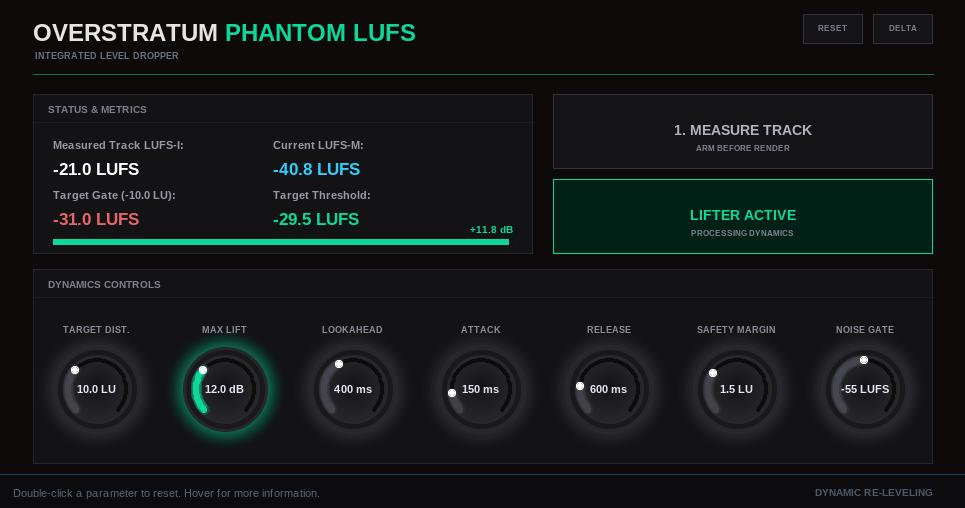
I built the Phantom LUFS exactly for this “cheat”. It is not an ordinary compressor, but a highly specialized dynamics rider designed precisely for this mathematical exploit.
- Target Range (LU): This defines the dynamic distance of the relative gate to the absolute average. The default is 10 LU, but you can adjust it to your material.
- Max Lift (dB): The absolute maximum gain the plugin is allowed to add (up to 36 dB) to lift the signals over the gate threshold.
- Noise Gate (Fade Out Threshold): A crucial feature. So that we don’t just pull up the noise floor (which would sound terrible), the fade-out threshold rigorously ignores everything below a certain LUFS value (e.g., -55 LUFS).
- Delta Listen: With a click on the Delta button, you hear only the isolated gain that the lifter is currently adding. Perfect for setting the `Lookahead`, `Attack`, and `Release` parameters as transparently as possible.
At the end of the day, the Phantom LUFS is a technical scalpel. It lowers your Integrated LUFS value on paper, while your track retains its full dynamic range and punch for the human ear. Try it on your next master bus and watch the LUFS meters.